Understanding Long COVID and ME/CFS
Here you will find short answers to common questions about Long COVID and ME/CFS (myalgic encephalomyelitis / chronic fatigue syndrome). They are based on international guidelines, information from the Swiss Federal Office of Public Health (FOPH) and what people affected experience.
Frequently asked questions
What is Long COVID?
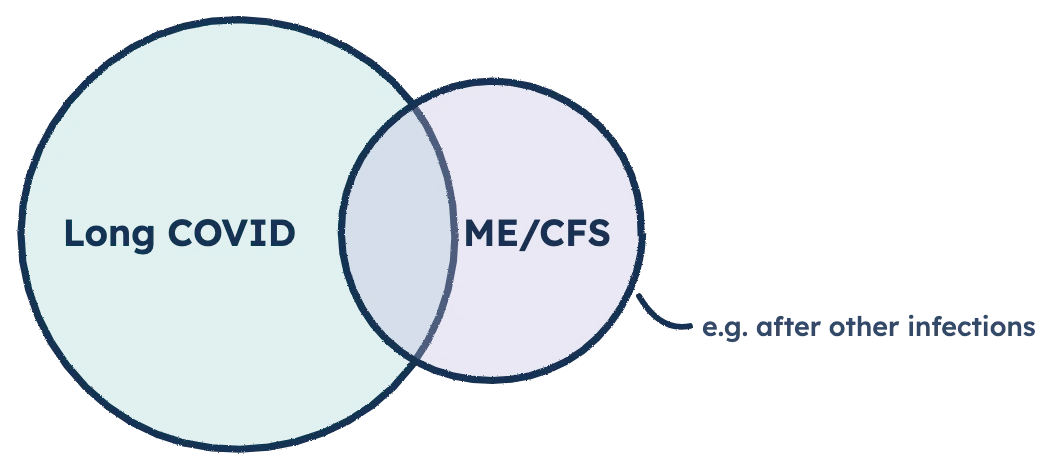
Long COVID is a physical illness that follows an infection with the coronavirus. The term Long COVID is used when symptoms last for more than three months after a confirmed or suspected infection and cannot be explained by anything else. This is how the World Health Organization (WHO) defines it, and Long Covid Switzerland uses it in the same way. Other names for it are post-COVID, post-COVID syndrome or post-COVID condition. The Federal Office of Public Health (FOPH) uses the term post-COVID-19 condition. Long COVID can also develop after a mild infection and can affect people of any age.
Long COVID is a multisystem illness. It throws different body systems out of balance, for example the nervous system, immune system, heart and circulation, breathing, digestion and metabolism. More than 200 different symptoms have been described.
At the centre are four core symptoms:
- Fatigue, meaning exhaustion caused by the illness
- Circulation problems when standing or sitting, for example a racing heart or dizziness
- A severely reduced capacity for exertion
- PEM, the worsening of symptoms after exertion
Problems with concentration and memory, shortness of breath, pain and sleep problems are also common.
Long COVID can become chronic and last for many years. Some people affected have been ill since the start of the pandemic, that is, for more than six years. The course of the illness varies greatly. The chances of improvement are best in the first 6 to 12 months, with plenty of rest, pacing and symptom relief. That is why support is so important, especially at the start. Some of those affected develop ME/CFS.
What is ME/CFS?
ME/CFS stands for myalgic encephalomyelitis / chronic fatigue syndrome. It is a severe neuroimmunological illness that affects many systems of the body. The World Health Organization (WHO) classifies it as a disease of the nervous system. ME/CFS usually begins after an infection, for example after COVID, glandular fever or flu. Some people with Long COVID develop ME/CFS. Long COVID and ME/CFS are not the same thing.
Its hallmark is PEM, post-exertional malaise: even small physical, mental or emotional efforts can make symptoms much worse, often only hours or days later. This worsening can last days, weeks or longer.
There are also many other symptoms, for example:
- fatigue: severe exhaustion that does not improve with rest or sleep
- unrefreshing sleep
- problems with thinking, concentration and memory (“brain fog”), such as difficulty finding words
- circulation problems when standing or sitting, for example a racing heart, dizziness or fainting
- muscle and joint pain, headaches
- strong sensitivity to light, noise, smells or touch
- flu-like symptoms such as a sore throat, tender lymph nodes or feeling feverish
- muscle weakness and difficulty regulating body temperature
- digestive problems and new intolerances
Which symptoms occur, and how severe they are, varies greatly from person to person. They often fluctuate a lot, even within a single day. There are mild, moderate, severe and very severe forms. Even a mild form clearly limits everyday life. People who are severely affected can hardly leave the house or their bed. People who are very severely affected often lie in a darkened room, can barely tolerate light, sound or touch, and need help even with eating and personal care.
There is no simple test yet. Doctors make the diagnosis using defined criteria and by ruling out other causes. So far there is no treatment that cures it. What matters is pacing, which means not going beyond your own limits, and relieving symptoms.
What is fatigue?
Fatigue is a symptom, not the illness itself. In Long COVID, and especially in ME/CFS, it is the best-known symptom and often the one with the greatest impact. But it is not the only one.
It means severe exhaustion caused by the illness. It is more than ordinary tiredness and out of all proportion to the effort. Sleep and rest are often not enough for recovery. Concentrating can also be very draining.
That is why you can’t compare it with your own tiredness.
What is PEM?
PEM stands for post-exertional malaise. It means that symptoms get much worse after exertion. Even minor exertion can be enough, whether physical, mental, emotional or social. The worsening often doesn’t come until hours or days later.
This is also called a crash. It can last days, weeks or longer. But it can also lead to a relapse or a permanent worsening. As a result, the illness can become chronic and more severe.
That is why going beyond your own limits is dangerous with PEM. Not everyone with Long COVID has PEM.

How much does the illness vary?
A great deal. Some have milder symptoms, others are severely limited in everyday life. People who are severely affected can barely leave the house or get out of bed and depend on help.
Energy and symptoms fluctuate, even from day to day. What was possible yesterday can be too much today. With many people, you can’t tell they are ill by looking at them. Someone who laughs and chats can still be seriously ill.
Are Long COVID and ME/CFS physical illnesses?
Yes. According to current scientific knowledge, Long COVID and ME/CFS are physical illnesses and not psychosomatic. The World Health Organization (WHO) classifies ME/CFS among the diseases of the nervous system. But the illnesses can be a heavy emotional burden. This is also due to outside circumstances: people affected still face major obstacles in society, with doctors, authorities and insurers. Many go through an odyssey lasting years before they finally get the support they need. This affects every area of life.
Blood tests and other standard tests are often normal. There is no simple test yet. The symptoms are real all the same. Because this is still not well enough known, the illnesses are often not recognised or wrongly classified.
For many, this becomes a fight for recognition. Many doctors and authorities still lack knowledge of these illnesses. In 2023, the Swiss Federal Council confirmed that limited knowledge in GP practices made it harder to diagnose and treat Long COVID.
Does moving more help?
Not as general advice. With PEM, pushing through or moving more can worsen the condition, even permanently. In that case, guidelines advise against exercise programmes that build up in fixed steps. With ME/CFS, such training can even cause long-term and irreversible harm.
In rehabilitation, too, many are told to go beyond their limits. People affected report this in a survey by three Swiss patient organisations (not representative). Almost half of the respondents with Long COVID said their health was worse after rehabilitation. With ME/CFS, it was almost two thirds.
People affected usually know their limits best. Comments like “Just move more” are often well meant, but they add pressure.
What is pacing?
Pacing means carefully budgeting your energy. People affected plan ahead, choose what matters most, slow down and take breaks in good time. Last-minute cancellations can be part of it too.
This lowers the risk of setbacks, but does not prevent all of them. Pacing is not a cure and not a training plan. You help by offering to lend a hand and by respecting breaks.
Why are some people affected registered with an assisted dying organisation?
In Switzerland, assisted suicide (often called assisted dying) is legal under certain conditions. Many people with Long COVID and ME/CFS have registered with an assisted dying organisation, among them the president of Long Covid Switzerland, Chantal Britt. She says: “Not because we want to die, but because the situation is no longer bearable for many of my fellow sufferers.”
The main reason is the lack of care. There are only a few doctors with experience of these illnesses, and specialised outpatient clinics have long waiting lists or have temporarily stopped accepting new patients. Many go for years without a diagnosis and without effective help. On top of that, there are years of procedures with insurers and the Swiss disability insurance (IV), a lack of recognition and financial insecurity. Chantal Britt says that today it is easier for people who are severely affected to get assisted dying than to get adequate care and support.
Registering is a personal decision. Treat it with respect, without blame and without panic. Above all, it shows how much support is missing and how severely the illnesses change the lived reality of those affected, often to the point where life is hardly bearable or worth living.
Will it get better?
That can’t be predicted with certainty. For many people with Long COVID, symptoms improve over time. For others, they last a long time, sometimes for years. With ME/CFS, the illness often lasts a long time, even though some people recover.
So far, there is no cure. But symptoms can be partly relieved. Research is ongoing, but according to the Federal Office of Public Health (FOPH), there are still gaps in knowledge about the causes and treatment of Long COVID.
Sources: D-A-CH consensus statement on ME/CFS, 2024, Rehabilitation survey 2024 (Long Covid Switzerland, ME/CFS Schweiz, SGME), Swiss Federal Council report on post-COVID-19 condition, 2023, FOPH (BAG) – Post-COVID-19 condition: what is the FOPH doing?, Long Covid Switzerland: What is Long COVID?, NZZ: Long COVID and disability insurance (IV), 2026
What helps most is believing people affected, even if you can’t tell they are ill by looking at them.