What people affected go through
Here, people with Long COVID and ME/CFS speak for themselves. Their experiences often go unheard. Yet they know best how they are doing.
Not recognised, wrongly classified
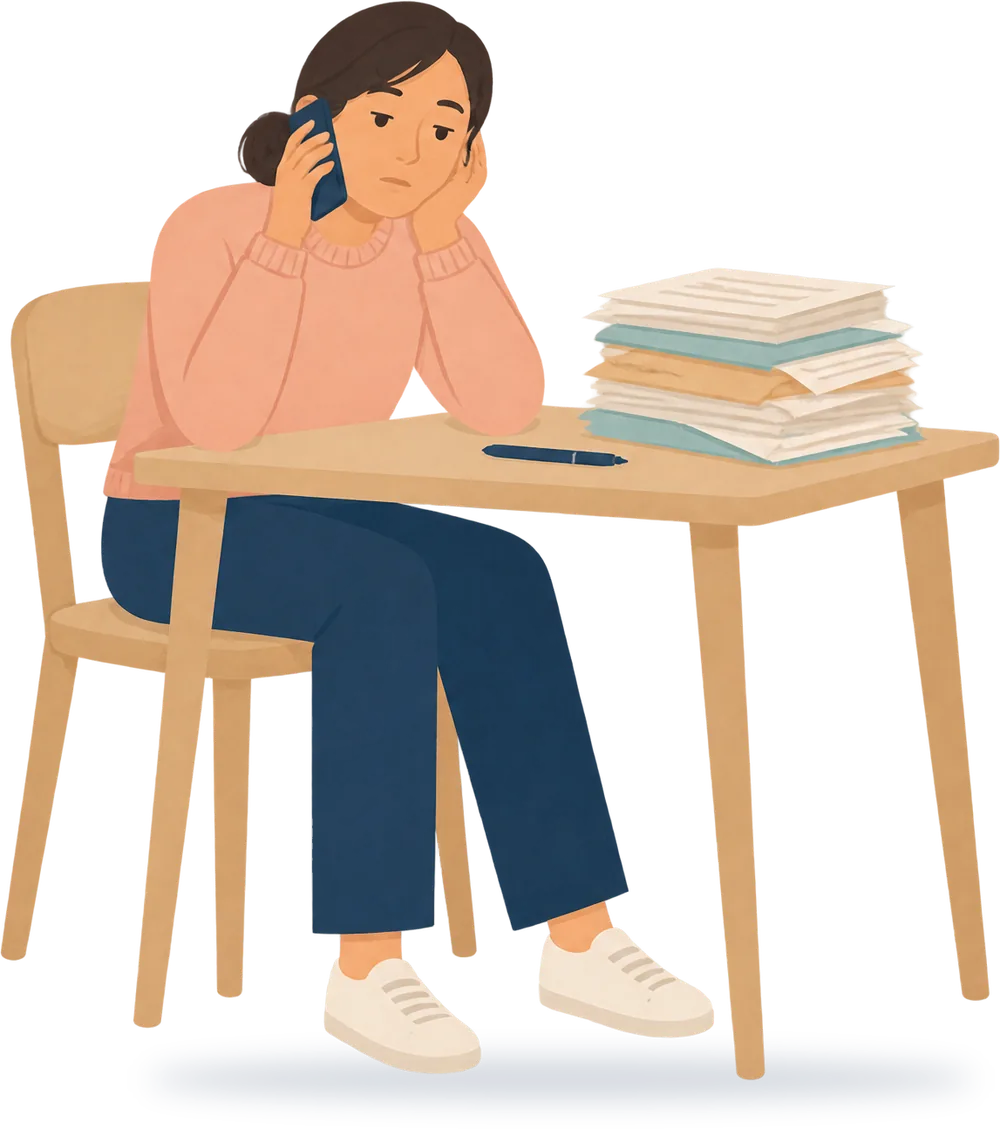
Standard tests often show nothing unusual, even though the illness is physical. That is why it is often not recognised or wrongly classified at the doctor’s.
Anyone who, despite real symptoms, is repeatedly left without an explanation and without help often starts to doubt themselves. People affected call this “medical gaslighting”.
Many doctors, insurers and authorities still know too little about these illnesses. Their causes and treatment have not yet been researched enough.
People affected pay the price. They report too few specialist services and months-long waiting times. Many wait years for a diagnosis of Long COVID or ME/CFS.
“My GP did not believe that anything like Long COVID existed.”
“They want to make me believe that it has nothing to do with COVID and is ‘psychological’ […]”
“I can’t find anything, so you must be imagining it.”
“The feeling of not being taken seriously is – apart from the unbearable symptoms – the worst thing about the illness.”
Years without a diagnosis
With Long COVID, as with ME/CFS, a marathon of doctor visits often begins: from one practice to the next, from one test to the next. With Long COVID it is not unusual for months or years to pass before the illness is identified. With ME/CFS it takes almost seven years on average, sometimes decades. People who still have no proper diagnosis hardly appear in any statistics. Experts even assume that most people with ME/CFS have no diagnosis at all or the wrong one.
In the more than 600 accounts from people affected and their families that were read for this website, no experience comes up as often as this one: the physical illness is not recognised or wrongly classified, often because the standard test results are normal. Quite a few end up finding the answer themselves: on the internet, in patient groups or through their family. Often the turning point only comes with one single doctor: someone who knows about the illness and listens.
This search costs energy, money and health. With PEM, even one doctor’s appointment can trigger a crash that lasts days or weeks. Some pay for tests and treatments themselves or travel long distances, even abroad. Others start to doubt themselves after years without a diagnosis. And some give up and stop going to the doctor altogether.
- Long Covid Switzerland survey (2022) of around 580 people with Long COVID: only 63% had a Long COVID diagnosis, compared with 25% a year earlier. 55% felt that doctors took them seriously only partly or not at all.
- Nationwide Swiss survey of 309 people with Long COVID (Inselspital Bern, 2021): on average they had seen 3.5 doctors, some as many as 25. 41% did not feel taken seriously.
- Study by the Universities of Basel and Zurich with 137 people with Long COVID (2026, not yet peer-reviewed): many describe a long road to diagnosis, and their symptoms were often wrongly classified as psychological.
- Swiss survey of 169 people with ME/CFS: on average, it took 6.7 years to get a diagnosis. Before that, they had seen 11 different doctors on average.
- In the same survey, 9 out of 10 had experienced a psychosomatic misinterpretation of their symptoms at least once.
“A lot was going on in my life at that time. So everyone put it down to stress.”
“I spent my entire teenage years running from one test to the next without ever having any clue what I was suffering from.”
“For years I did my own research on the internet, and that’s how I worked out the diagnosis myself. There are only a handful of doctors in Switzerland who can confirm this diagnosis.”
“The doctors don’t know the illness, and I always get put in the psychiatric box.”
“In the past, it was often said to be ‘psychological’. That is slowly changing, but it takes time. It still takes seven years on average to get a diagnosis.”
Sources: Long Covid Switzerland survey, 2022, Diem et al., Swiss post-COVID survey (Inselspital Bern), 2022, Böhm, Frei et al., Living with Long Covid (Universities of Basel and Zurich, preprint), 2026, Swiss ME/CFS survey (Swiss TPH, University of Basel), 2023, D-A-CH consensus statement on ME/CFS, 2024
When treatment does harm
Some are pushed to move more, often during rehabilitation too. With PEM, this is dangerous. A crash can last days or weeks. But it can also make the condition permanently worse.
In a survey by three Swiss patient organisations, 47 per cent of respondents with Long COVID said their health was worse after rehabilitation. With ME/CFS, it was 63 per cent. In rehabilitation, many were told to go beyond their limits.
Some had to stop rehabilitation early. Others kept going anyway, because of money worries or for fear of trouble with their insurers.
“Talking for an hour is really very hard for me. So I kept having crashes linked to the psychotherapy sessions.”
Sources: Rehabilitation survey 2024 (Long Covid Switzerland, ME/CFS Schweiz, SGME), D-A-CH consensus statement on ME/CFS, 2024
Brain Retraining: an old error, repackaged
Courses and coaching in “Brain Retraining” are being offered more and more often in Switzerland too, now even by hospitals. The idea behind it is that the brain keeps the symptoms going, and that people who retrain their thoughts and behaviour will get well again. Well-known programmes cost several hundred US dollars or more. There is no evidence that they cure Long COVID or ME/CFS. Long COVID and ME/CFS are physical illnesses. They cannot be thought away or trained away.
The Swiss ME organisations put it like this: the only new thing about it is the marketing. Since the 1980s, there have been attempts to reinterpret ME/CFS as learned behaviour, false beliefs about illness or the result of avoiding exertion. For decades, such explanations shaped research and treatment. No benefit was ever proven. Experts from Germany, Austria and Switzerland state in the D-A-CH consensus statement: it is wrong to assume that psychological factors cause ME/CFS. Long Covid Switzerland is just as clear: a psychosomatic cause of Long COVID, ME and CFS has been scientifically disproven.
Switzerland shows how old this way of thinking is: in 2008, the Swiss Federal Supreme Court assigned chronic fatigue syndrome “clearly to the somatoform disorders”, in other words to symptoms explained as psychological. According to the Swiss ME organisations, the illness was therefore regarded as something that could be overcome with “reasonable effort of will”, and a pension from the Swiss disability insurance (IV) was out of reach until 2015. Even today, many expert medical reports wrongly classify ME/CFS as psychosomatic.
It becomes dangerous when PEM is interpreted as fear or avoidance. People affected are then pushed to ignore their symptoms and become more active. With PEM, this is exactly what can cause severe and sometimes permanent worsening. Many people affected report that this left them bedbound. The British NICE guideline on ME/CFS explicitly advises against exercise programmes that build up in fixed steps, and against the “Lightning Process”, a well-known Brain Retraining programme.
Relaxation, breathing exercises or psychological support can help people live better with a serious illness. The patient organisations do not deny this either. But based on current knowledge, these approaches cannot cure Long COVID or ME/CFS. If someone stays ill, it is not because they did not want it enough or thought the wrong way. No one is to blame for their own Long COVID or ME/CFS.
“We criticise the fact that these programmes are offered to those of us affected – almost forced on us – at the expense of evidence-based scientific approaches and off-label treatments.”
“[The person who is ill] is supposed to work on themselves to get well, and if that doesn’t work, then it’s just their own fault.”
Sources: Long Covid Switzerland: position statement on biopsychosocial and neuroplastic models, 2026, SGME and ME/CFS Schweiz: statement on biopsychosocial and neuroplastic models, 2026, Swiss Federal Supreme Court, judgment I 70/07 of 14 April 2008, D-A-CH consensus statement on ME/CFS, 2024, NICE guideline NG206 on ME/CFS, 2021, WOZ: “A cure in three days?”, 2026
The fight with insurers and authorities
Many fight for recognition for a long time. With the Swiss disability insurance (IV), the process often takes years.
Many tell of expert medical reports that wrongly classify their illness. Some are declared fit for work even though they have been signed off sick.
The assessments alone drain a lot of energy. In a survey by the Schweizerische Gesellschaft für ME & CFS, most people affected who had applied for a pension said the strain of the process had made their condition worse. For more than one in five, the worsening was severe and permanent.
For the expert medical report in her IV case, a 26-year-old woman with severe Long COVID and ME/CFS had to travel to appointments in three different places. After each appointment she had a crash, a complete collapse. Today she receives a full IV pension. Because of cases like hers, the national association of IV offices wants to draw up Switzerland-wide recommendations. They are for people who, according to their doctor, can travel or take part in an assessment only to a limited extent.
“Now I can pay for my food and my doctors’ bills myself – and at least financially I am no longer a burden on my parents.”
“In their decision they recognise my diagnoses, but they consider me 100% fit for work. I was stunned. I had doctors’ reports saying I could not work more than 40%.”
“I felt like I was being interrogated. There was no smile, no compassion, no interest”
“We keep running into walls.”
Sources: D-A-CH consensus statement on ME/CFS, 2024, NZZ: Long COVID and disability insurance (IV), 2026
Work and money
For months, many cannot work at all, or only partly. Some meet with distrust at work because they are often absent but look healthy. Some lose their jobs.
For some, payments from their daily sickness benefit insurance run out before the disability insurance (IV) has made a decision. Then money gets tight. Some have to rely on social assistance or on their parents.
“In a situation like that, you’d need support, not to be fired.”
“And then you’re off sick for quite a long time, with an illness that’s new and can’t be proven, and you fall through the cracks everywhere.”
When people around them withdraw
Many find that friends or family have doubts too, because the illness cannot be seen. For some, understanding fades over time, and contacts and relationships fall apart.
Some are so severely ill that they can barely leave the house or get out of bed. For many, family and close friends are their most important support. Some are cared for by them.
“They think I am exaggerating, that all it takes is going out for a short walk to get better.”
“Many people don’t really understand. When you tell them you’re tired, they say ‘We all are’, ‘You’re not 20 any more’ or ‘You work too much’. But for me there is a before and an after COVID.”
“I always have to tell the same story, over and over again and people still do not understand the disease.”
“I was left unsupported and isolated by everyone … family, friends, physicians – because nobody knew ME/CFS”
Typical things people affected hear
- Instead of“But you look well.”Better“I believe you, even if it doesn’t show.”
- Instead of“Surely it’s psychological.”Better“I know it’s a physical illness. I take you seriously.”
- Instead of“Just move more.”Better“You know your limits best.”
- Instead of“Pull yourself together.”Better“It’s not a question of willpower. What would help you today?”
What really helps
What people affected want most is to be seen and supported, and to have the reality of their lives taken seriously. There are doctors who do exactly that and listen. That is how it should be everywhere.
What also helps:
- Understanding instead of advice.
- Respecting limits and breaks, not pushing.
- Practical help: shopping, meals, housework, dealing with authorities.
- If the person wants: going with them to appointments, helping with letters and forms.
- Staying in touch, even when plans to meet fall through.
“My new GP is very good – she sees me as a human being and takes me and my symptoms seriously.”
People affected need people who believe them.
The quotes come from publicly available reports and studies – private individuals are not named.